
‘Godzilla Minus One’: an enthralling, humanistic monster movie
As always, spoilers abound. Watch the film first or consider yourself warned.
I am not typically the target audience for modern Godzilla films. Removed from the context of a shell-shocked post-World War II society, into which Godzilla was born in the original 1954 film, I find him to be a little ridiculous. I was astonished, then, to discover that “Godzilla Minus One” is a phenomenal film. Not “good for a monster movie,” but a real, honest-to-goodness film with compelling characters and substantial things to say.
The film revolves around Kōichi, a kamikaze pilot in 1945 who finds himself unable to go through with his mission — not once, but twice, leading to the annihilation of an entire garrison at the hands of a (relatively) small, not-yet-mutated Godzilla. The creature, of course, goes on to become a colossal, indestructible terror after being exposed to nuclear bomb testing at Bikini Atoll in 1946.
We follow Kōichi’s life for several years after the war as, like Japan as a whole, he strives to rebuild his life while struggling with the demons wrought by the conflict: demons like guilt, trauma and loss that are handled with intensely moving gravitas. An impromptu family unit springs up around him when a woman called Noriko and her adopted baby, Akiko, find shelter in his homestead. They proceed to live like a family, though Kōichi is hesitant to make it official, perhaps feeling that he is unworthy of happiness given his actions during the war.
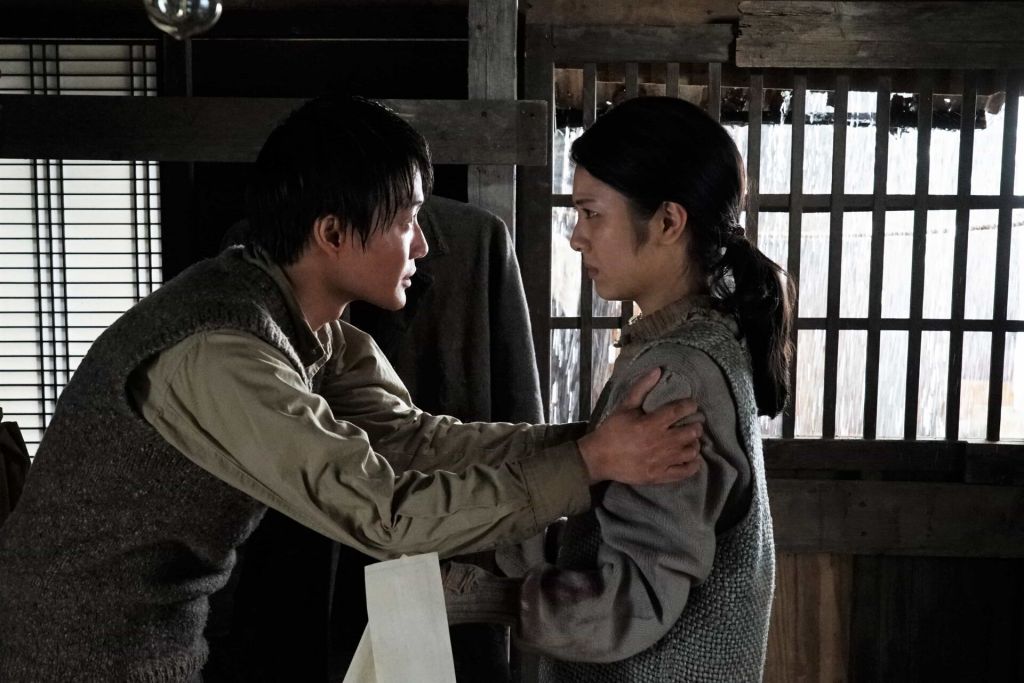
About 30 minutes into the film, I found myself realizing that I would be happy to watch these characters even without the presence of a giant, irradiated prehistoric monster. The story feels, during this early stage, like a slice-of-life picture documenting the post-war struggles of people who seem to have been caught in the middle of something far bigger than themselves and well out of their control.
“Come back alive — isn’t that what you said?” Kōichi asks aloud at one point, addressing his parents after their deaths in the bombing of Tokyo. How does one live with themselves when it feels like a crime to be alive?
These are not questions asked in the likes of the recent spate of stateside “Godzilla” movies, and this degree of depth has been rare even in Toho’s Japanese films over the last half-century. If it feels like I’m cheerleading the film’s intellectual and emotional power a bit too earnestly, it’s because I recently read a review by Simon Abrams of RogerEbert.com that makes me wonder whether the quality of storytelling in “Godzilla Minus One” was so unexpected to some folks that it induced a kind of hysterical denial.

Abrams, at various points in his review, decries the “nationalistic passion [that] is apparently essential to fighting Godzilla,” reduces the film’s themes to “reviving Koichi’s (sic) ultimately patriotic mojo,” bafflingly describes it as “the most conventional Godzilla movie in recent memory” and, with unaccountable scorn, calls this anti-war, anti-nuclear and intensely humanistic film a “saber-rattling melodrama” with “conservative” politics compared to previous films in the franchise.
Abrams seems to have fallen off his rocker, and while his views are just a drop in a sea of positive views, they irk me for their haughty flippancy. His criticisms seem to largely revolve around the view that the film somehow glorifies or endorses war, despite its entire thematic thrust revolving around Kōichi’s eventual realization that he can make a difference without sacrificing his life needlessly. The climax of the film is based around inventive logic and the minimization of casualties, with an empty ship used to draw Godzilla’s devastating (and explicitly nuclear) “heat ray” so as to avoid mass deaths in the final battle. While a lesser film might have resolved Kōichi’s struggle with survivor’s guilt and the conflict between his perceived cowardice and sense of duty by having him sacrifice his life to defeat Godzilla, he instead rights a wrong of the war by making use of an ejector seat in his plane, challenging his government’s narrative that the ultimate self-sacrifice is necessary to serve his country.
Furthermore, these themes, combined with the film’s anti-nuclear sentiment — finally explicit again 70 years after the original’s strident messaging — is important in an era when the Japanese government is slowly but steadily creeping toward more nuclear development and a stronger military over the opposition of much of its populace. This is a powerful film at an important time, and if Abrams has a problem with the politics, he would do well to describe his issues more specifically rather than sprinkling his review with vague asides.
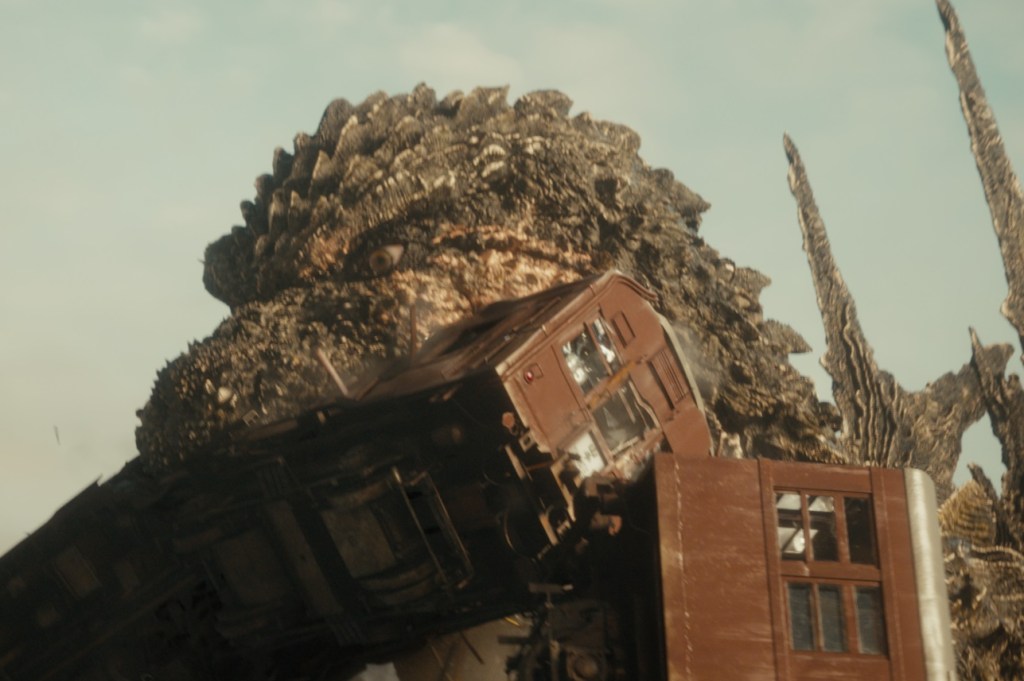
Putting Abrams aside, there is a lot to love here beyond the themes presented. The score is relatively simple but incredibly effective, amplifying the emotive power of tragic or psychologically intense scenes that already leap off the screen from the performances alone. Godzilla is given the majesty he deserves, and there is a nice touch when, having become a giant, radioactive menace, he walks more stiffly, more robotically than before, as if he has lost a piece of his soul in transitioning into the king of war machines. In fact, when compared to his more animalistic appearance pre-mutation, he almost looks more…human.
A few contrivances toward the end feel a little obvious or convenient, but they don’t derail the proceedings, and they enable the film to end on an exalted note of hope after two hours of intense emotional labor. If I have one bone to pick, it’s with the fate of the eponymous monster. I understand that this is a franchise and that provisions must be made for the future, but this story feels so self-contained in its own perfectly-crafted world that I can’t help but wish the loop had closed here.
I’ll leave you with this: If you feel exhausted by the big-screen monster mash wrestling matches we’ve been subjected to over the last decade, give “Godzilla Minus One” a try — it’s finally available on Netflix. I think you’ll be pleasantly surprised.
 Earth Critic